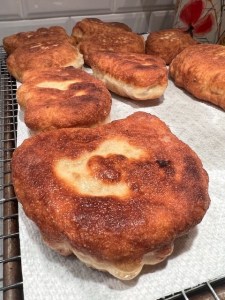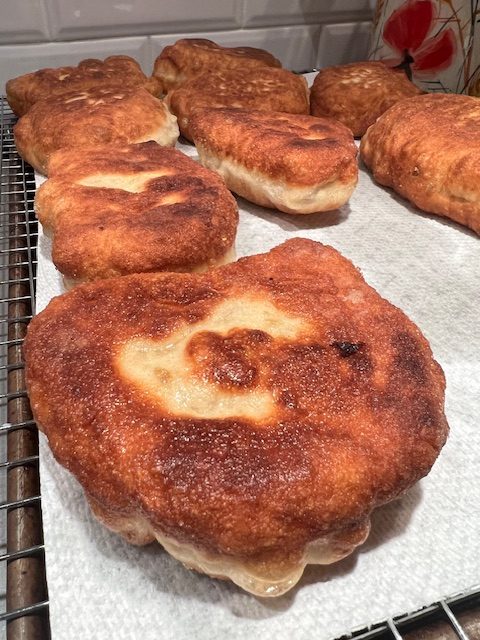
It wouldn’t be Christmas without frittelle, these savory cheese-filled bites that originated in Molfetta, a small town north of Bari, Italy.
They are somewhat similar to a calzone as we know them in New York pizza joints or empanadas as the Spanish and Latin Americans make, though these are often baked. If you’ve been to Bari or the Puglia region, you might find a similar snack called panzerotti. Some descriptions suggest frittelle are smaller than panzerotti though that has not been my experience. The actual translation of la frittella is the pancake, which really doesn’t begin to do it justice.
My dad’s family hailed from Molfetta and one of the many delicious traditions they brought to the US were these frittelle. We had them twice a year — on Christmas Eve served alongside pasta in red sauce with assorted seafood and again on New Year’s Eve when we replicated the meal from Christmas Eve. Don’t ask me why, I still have no idea.
I only recently learned some refer to a “frittelle season,” or the period between St. Martin’s Day on Nov. 11 and the Christmas holidays. Other regions in Italy make and eat them differently. For example, Venetians sweeten the dough with pine nuts and raisins, sprinkling powder sugar on top while hot during Carnivale.
I remember my grandmother making this dough from scratch, working chunks of potato into it. I’ve not been quite that ambitious and don’t recall my mom doing it that way either. I have found (much to my delight) that Trader Joe’s pre-made dough more than gets the job done.
One trick I recently learned on Instagram is to “re-proof” store-bought dough by putting it on an oiled pan in an unlit oven alongside a bowl filled with boiling water, I leave it there for a few hours so it can rise and get rehydrated. It becomes so pliable and easy to roll out. Highly recommend.
In our family, we have three kinds of frittelle — straight mozz (my favorite), mozz and ricotta, and the ones only my father and his brothers ate — anchovies, tomatoes and parsley. These were cooked last to avoid tainting the oil. Really, you could put anything in these and they’d be delicious though it’s hard to top fried dough and cheese.
One dough from Trader Joe’s gets you about six fritelle of about four-inches wide; they “grow” once fried. Once you cut the dough into six, you can either manually stretch it out or use a rolling pin on a lightly floured surface. I make them about 7-8 inches long and about 4-5 inches wide. You could make them smaller or larger depending on whether they are more central to the meal or appetizers.
Put the filling on one end, quick grind of salt and pepper and leave enough border so you can dab water and better seal the dough to prevent leaks during frying. Fold the top half over the filled bottom and cinch the two sides together. Some people press down with a fork end to create a seal; I just fold them up and squeeze so you create a nice doughy border. Poke a few holes in top to release steam and fry them in vegetable oil – just a few minutes on each side so they’re brown and luscious.
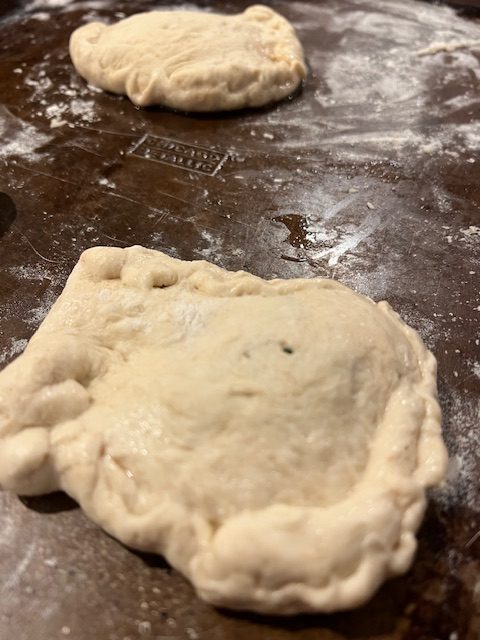
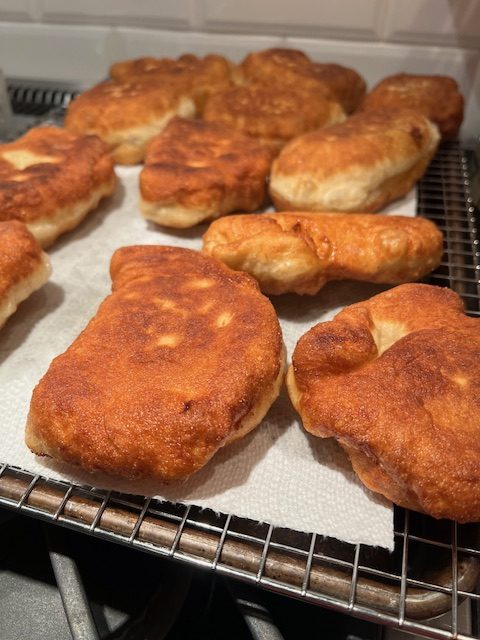
Waiting for the frying pan and after.
In our family, frittelle are eaten on their own or serve as what Italians commonly refer to as la scarpetta, “the little shoe” to mop up pasta sauce from the plate. They reheat quickly in an air fryer or toaster oven, making a great lunch with a salad or, in my case, a big bowl of insalata di mare.
Have you ever made these? Let me know if you try them out.