“Bolognese” can refer to a person from Bologna, one of the oldest Italian cities dating back to 600 BC, or a slow-braised sauce with meat of some kind. And in Bologna, they don’t the sauce Bolognese; they just call it ragu, because it’s so closely identified with the city and its Emilia-Romagna region.
I didn’t grow up eating Bolognese in our NY household, though our “gravy” each Sunday did involve braised meats of all kinds in a red sauce. (We’ll leave the gravy vs. sauce debate for a different day!) So I came to Bolognese as an adult, in part because it was exactly the kind of hearty, warming meal to accompany a glass of red wine on a fall or winter night.
I’m a little embarrassed to admit now, it was Rachel Ray’s 1998 book 30-Minute Meals that provided the first recipe I followed. No disrespect to Rachael Ray, but the whole concept you should cook a Bolognese in 30 minutes and, perhaps more galling, using garlic, a lot of tomatoes and no milk is an anathema to the beauty of this food that has become one of my favorites.
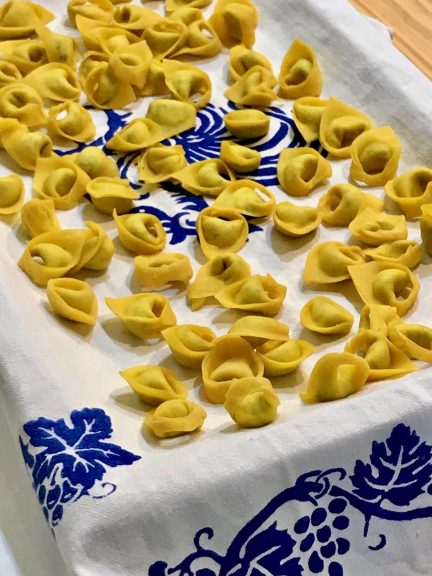
Thankfully I was set onto the path of deliciousness in 2018 during a food and wine tour of that region provided by Ecco La Cucina. We spent four days in Bologna, so I ate my share of the delicious ragu. Perhaps the best part, though, was spending one whole day with Luciana, who runs a cooking school out of her home in the hills surrounding Bologna. We made fresh tortellini and cooked in a sage/butter sauce, fresh tagliatelle to be topped with the official recipe of classic Bolognese and tiramisu. Here are some photos from that delicious day.


Their ragu is so different from what we most often encounter in the U.S. For one, it’s light on tomato and very meat forward, whatever that meat is. It can be beef, pork, duck, lamb but the meat is the star of this show; all other characters play a supporting role. And none of those characters includes garlic! In fact, to carry the stage metaphor forward, it’s as if the cast is picked precisely to blend into the background and not dim the star’s light.
The recipe Luciana taught is supposedly the official recipe for Bolognese, as filed at the Accademia Italiana della Cucina (Italian Academy of Cooking) in 1982, though it varies slightly � she doesn’t include broth and doubles the wine and milk. But I can attest to its deliciousness, the day we first made it and the many times I’ve made it since. While these proportions likely serve four, I generally double, triple and even quandruple it when I make so I serve larger groups or freeze to enjoy another time.
Ingredients
Beef 300g
Bacon* 150g
Carrot 50g
Celery 50g
Onion 50g
Tomato sauce 220g (She used Mutti)
Dry white or red wine 1 glass
Whole milk 1 glass
Salt and pepper
While many recipes call for bacon, it’s not the bacon we are used to in the US and you’d be better off using pancetta, which is what I do.
Her prep differs in a meaningful way. While many recipes call for a fine chop on the bacon/pancetta, Luciana has you chop it and put it into the food processor to turn it into a paste. In this form, it’s almost guaranteed to blend into the background, providing a hint of porkiness without overtaking the palette. Into a dutch oven to start to melt.

Then she used the food processor with the shredder attachment for the carrot, celery and onion, with the hardest going in first, so these too easily fall apart during the long simmer. Once these have softened with the pancetta, add the meat. We generally grind our own beef, using chuck roast or any cut of beef that has some fat in it. I’ve read skirt or hanger steak is a good option as well, but haven’t tried. Once the meat is sizzling and the pink is gone, you can add the wine and give it about 5-10 minutes to evaporate. The tomato sauce is next and then it’s time to settle in for a 1.5-2 hours uncovered to let it simmer, stirring every 15 minutes or so. It would be incredible to have a candle that smells like this!
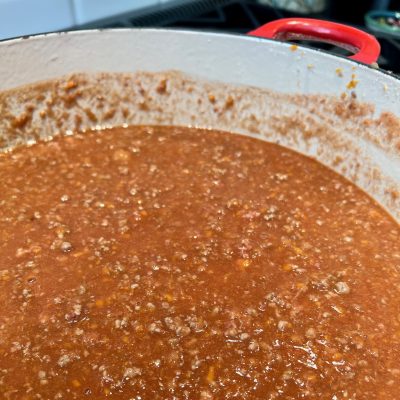
After that time, you add the warm milk and let it simmer for another 20 minutes or so. When it all looks blended and homogenous, you can add salt and black pepper as needed. Serve and be wowed.
Whether this is “the” official recipe or not is irrelevant, because Italians like to tweak things to make it their own. The key piece to remember is this is a meat sauce, not a sauce with meat. Italians tend to serve it over a flat wide pasta like pappardelle or tagliatelle, though I love it over rigatoni as well. Serve it with a hearty salad and you’ve got a wonderful meal. Buonissima!